

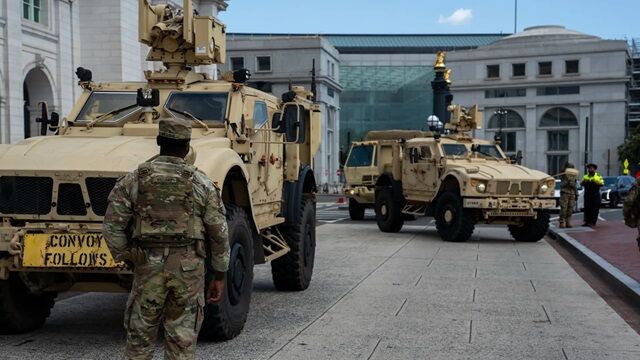
The real issue in all of this is that the president is nowhere authorized in the US Constitution to call up the militia, the fake federalized militia or the military. Instead, it is Congress’ duty to do that and they simply have not done that in order for President Trump to become commander-in-chief over them. Yet, he is attempting to just run as a dictator, calling up troops to be sent on American streets illegally. Now, he’s asking the supreme Court to get behind his lawlessness.
Courthouse News Service has the story.
The Justice Department argues that only the president can determine if there’s a rebellion.
Get Daily Emails
WASHINGTON (CN) — President Donald Trump asked the Supreme Court Friday to intervene in support of his efforts to extinguish protests with military force, urging the justices to lift a lower court order barring the deployment of National Guard troops to the Chicago area.
U.S. Solicitor General John Sauer urged the justices to take immediate action, claiming that the continued prohibition on the deployment of federal troops increased the risk that officers would be seriously harmed by what he called “violent anti-ICE agitators.”
“The injunction should be stayed so that federal enforcement of federal immigration law in Chicago is not left to the mercy of hostile state and local officials — or violent mobs,” Sauer wrote.
Trump claims that clashes between protesters and law enforcement officers have hindered immigration enforcement. He’s invoked a statute known as Title 10 to assert federal authority over Illinois’ National Guard.
The rarely used statute can only be utilized when the country faces foreign invasion, the U.S. government faces rebellion, or the president is unable to execute laws with regular resources.
In a social media post on Friday, Illinois Governor JB Pritzker called Trump’s attempted troop deployment an invasion and promised to defend the sovereignty of the state.
“Militarizing our communities against their will is not only un-American but also leads us down a dangerous path for our democracy,” Pritzker wrote. “What will come next?”
Illinois sued the administration in early October after Trump ignored state and local officials’ repeated objections to the use of troops against protesters.
Two lower courts determined there is no active rebellion in Chicago, with an appeals court stating, “political opposition is not rebellion.” A unanimous panel on the Seventh Circuit also rejected claims that protest activity in Illinois hampered federal officers from executing federal immigration laws.
Trump said the rulings were part of “a distributing and recurring pattern,” referencing his previous attempts to deploy the National Guard against protesters in Los Angeles. He said protests against federal immigration enforcement constituted a “rebellion or danger of rebellion.”
A suburban immigration processing facility in Broadview has become the epicenter of a standoff between protesters and Immigration and Customs Enforcement officers in Illinois.
Viral videos of have shown officers pointing guns at protesters and deploying smoke grenades and tear gas. One video shows an officer throwing Democratic congressional candidate Kat Abughazaleh to the ground. Another shows an officer firing projectiles from close range at a Presbyterian minister, who then collapses.
Nonetheless, the White House has continued to frame protesters as violent agitators. It argues the Broadview protests constitute a rebellion.
Claiming that judges can’t review the president’s opinion, the Justice Department says it doesn’t matter if courts disagree with the White House’s assessment. Under an 1827 Supreme Court ruling known as Martin v. Mott, the administration claims that only the president can determine whether there’s a rebellion or invasion.
“A federal district court lacks not only the authority but also the competence to wrest control of the military chain of command from the commander in chief,” Sauer wrote.
The Supreme Court has asked Illinois to file a response to Trump’s application by Oct. 20 at 5 p.m.
Article posted with permission from Sons of Liberty Media


